Call Me
Domestic:+86-18169817259
Oversea:+86-13790081902
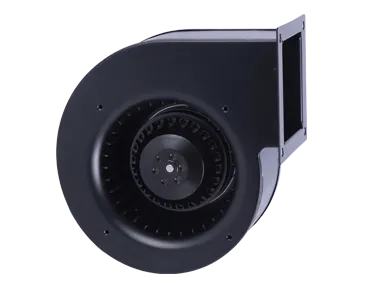
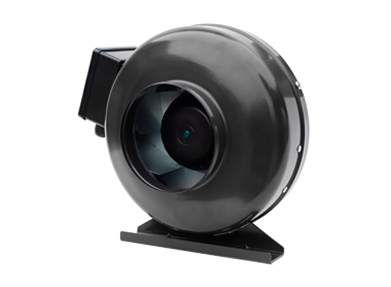
In high-performance Energy Recovery Ventilators (ERV) and Air Handling Units (AHU), the integration of centrifugal fans with Permanent Magnet Synchronous Motors (PMSM) is critical for achieving Tier-1 energy efficiency. However, the resulting Acoustic Power Level (Lw) often dictates product marketability. This report identifies primary aeroacoustic and electromagnetic noise sources and proposes a system-level mitigation framework designed to achieve a minimum 5 dB(A) reduction in Sound Pressure Level (SPL) without compromising volumetric low rate or static pressure.
2. Aeroacoustic Source Identification in Centrifugal Fans
Centrifugal fan noise is fundamentally categorized into tonal (discrete) and broadband (stochastic) components, driven by complex luid-structure interactions.
2.1 Tonal Noise (Discrete Frequency)
Tonal noise is dominated by the Blade Passing Frequency (BPF) and its harmonics. This occurs as rotating blades periodically pass the volute tongue (cut-of), creating localized pressure
pulsations.
● Mechanism: The BPF is calculated as n*z/60 , where n is RPM and z is the number of blades.
● Key Source Location: The interaction between the high-speed impeller discharge and the stationary volute tongue.
2.2 Broadband Noise (Turbulence-Induced)
Broadband noise lacks a specific frequency peak and is characterized by a wide-spectrum "hissing" or "rushing" sound.
● Mechanism: It originates from turbulent boundary layer separation, vortex shedding at the trailing edge, and inlow turbulence ingestion.
● Key Source Location: Inlow bell mouth (Inlet), blade suction side, and wake regions at the impeller exit.
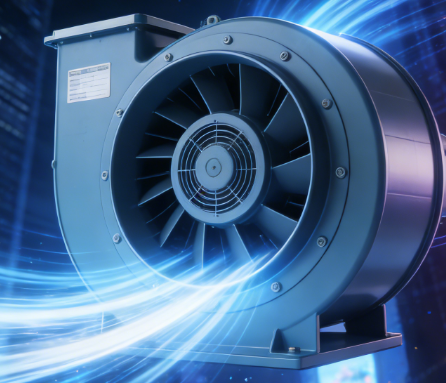
3. Electromagnetic and Mechanical Noise in Outer-Rotor PMSMs
For HVAC applications, outer-rotor PMSMs are preferred for their high torque density, but they introduce specific NVH (Noise, Vibration, Harshness) challenges.
3.1 Radial Force Waves and Resonance
The primary source of magnetic noise is the Radial Electromagnetic Force (REF) waves acting on the stator teeth and rotor housing.
● Mechanism: These forces cause periodic structural deformation. If the frequency of these force waves aligns with the natural frequencies of the rotor housing (often around 2000
Hz), severe resonance occurs.
● Cogging Torque: Interaction between permanent magnets and stator slots creates torque ripple, manifesting as low-frequency vibration.
3.2 Inverter-Induced Harmonics
Pulse Width Modulation (PWM) strategies in motor drives introduce high-frequency "switching noise" or "whistling".
● Mechanism: Fixed-frequency PWM concentrates energy at the carrier frequency and its multiples, which are highly audible to the human ear [5.
4. Integrated Noise Mitigation Framework (Target: >5 dB Reduction)
4.1 Structural Solution: Biomimetic Owl-Inspired Volute Tongue
Inspired by the serrated plumage of the Asio otus (Long-eared owl), a multi-layer biomimetic cut-of is implemented to address BPF tonal noise.
● Implementation:
1. Top Layer: Biomimetic micro-slotted plate (1–2mm thick) for laminar low rectification.2
2. Middle Layer: Micro-perforated plate (MPP) acting as a Helmholtz resonator array to dissipate acoustic energy.2
3. Base Layer: 8–10mm air cavity to provide phase-shifting for sound wave interference.2
● Acoustic KPI: Achieves a 3–5 dB(A) reduction in overall SPL for high-noise fans.2
4.2 Geometric Optimization: 2° Slanted (Inclined) Volute Casing
The pressure gradient at the volute exit is a major contributor to low-frequency "rumbling".
● Implementation: Redesigning the volute casing with a 2° downward inclination relative to the impeller plane.3
● Mechanism: This increases the efective cross-sectional area at the bottom of the scroll, reducing the pressure gradient and mitigating low separation.
● Acoustic KPI: Reduces discharge noise by approximately 1.2–1.5 dB(A) while maintaining or slightly improving volumetric efficiency.3
4.3 Control Strategy: Harmonic Injection & RPWM
Software-level optimization of the PMSM drive provides cost-efective noise suppression.
● Harmonic Compensation: Injecting 3rd and 9th order harmonics into the SPWM signal waves to reshape the current to a "saddle" profile, reducing current ripple by up to 25%.
● Random Carrier PWM (RPWM): Randomizing the switching frequency to spread the electromagnetic energy across a broader spectrum [5.
● Acoustic KPI: Converts piercing tonal "whistles" into a smoother broadband background, significantly improving psychoacoustic sound quality and contributing a 1.5–2.5 dB
reduction in measurable magnetic noise [5.
5. Summary of Engineering Measures
Optimization Dimension | Proposed Specification | Primary Acoustic Target | Targeted Attenuation |
Aeroacoustics | Biomimetic MPP Volute Tongue | BPF Tonal/Rotation Noise | 3.0 - 5.0 dB(A) |
Flow Dynamics | Slanted Volute (2° Downward) | Turbulence/Broadb and separation | 1.2 - 1.5 dB(A) |
Wall Treatment | Flange Circular Micro-dimples | Boundary Layer stabilization | 1.0 - 2.0 dB(A) |
Motor Drive | 3rd/9th Harmonic Injection | Magnetic Force/Current Ripple | 1.5 - 2.5 dB |
Modulation | Randomized Switching Frequency | High-frequency Switching Whistle | Peak Energy Spreading |
6. Conclusion for Specifying Engineers
To achieve a competitive edge in ERV/AHU acoustic performance, it is recommended to move beyond passive attenuation (insulation) and adopt active source-level suppression. By
combining Biomimetic Volute Geometries with Advanced Inverter Control Strategies, a cumulative attenuation of >5 dB(A) is achievable without significant BOMS (Bill of Materials) cost increases.2 Future designs should prioritize the synchronization of the motor carrier
 frequency with the structural resonances of the fan housing to prevent secondary NVH amplification.
Quick Links
 中文
中文  English
 한국어
한국어 français
 Deutsch
 Español
 italiano
 русский
 português
 العربية
 Türkçe
 Polska