Call Me
Domestic:+86-18169817259
Oversea:+86-13790081902
The main difference between axial and centrifugal fans is how they move air and respond to system resistance. Axial fans move air in a direction parallel to the fan shaft and are generally suited to high-airflow, low-pressure applications. Centrifugal fans draw air into the impeller and discharge it outward in a radial direction, allowing them to generate higher static pressure when airflow must pass through ducts, filters, coils or other restrictive components.
In simple terms, an axial fan is often the better choice when you need a large volume of air with relatively low resistance, while a centrifugal fan is usually more suitable when the system requires higher pressure to overcome resistance.
However, airflow direction is only part of the difference. Axial and centrifugal fans also vary in static pressure capability, system performance, installation requirements, efficiency, noise characteristics and suitable applications. Understanding these differences is essential when selecting a fan for HVAC equipment, industrial ventilation, refrigeration, air handling units or equipment cooling.
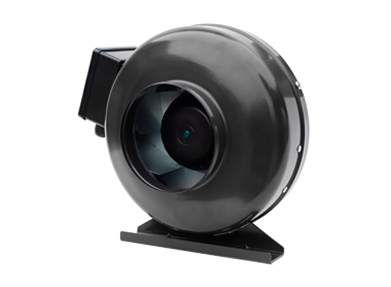
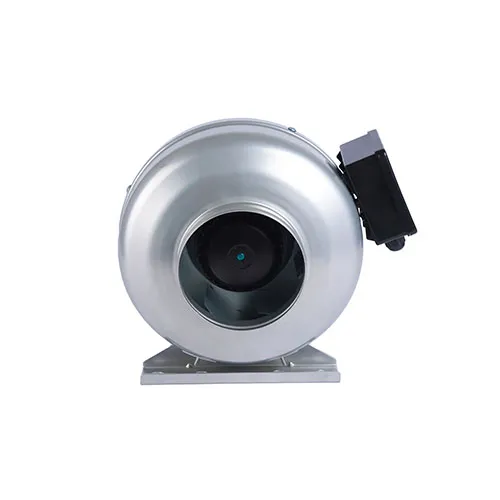
SunxFan manufactures EC, DC and AC fan solutions for HVAC and industrial ventilation applications. Its product range includes Axial Fans, Centrifugal Fans and Duct Fans for equipment manufacturers and ventilation system buyers.
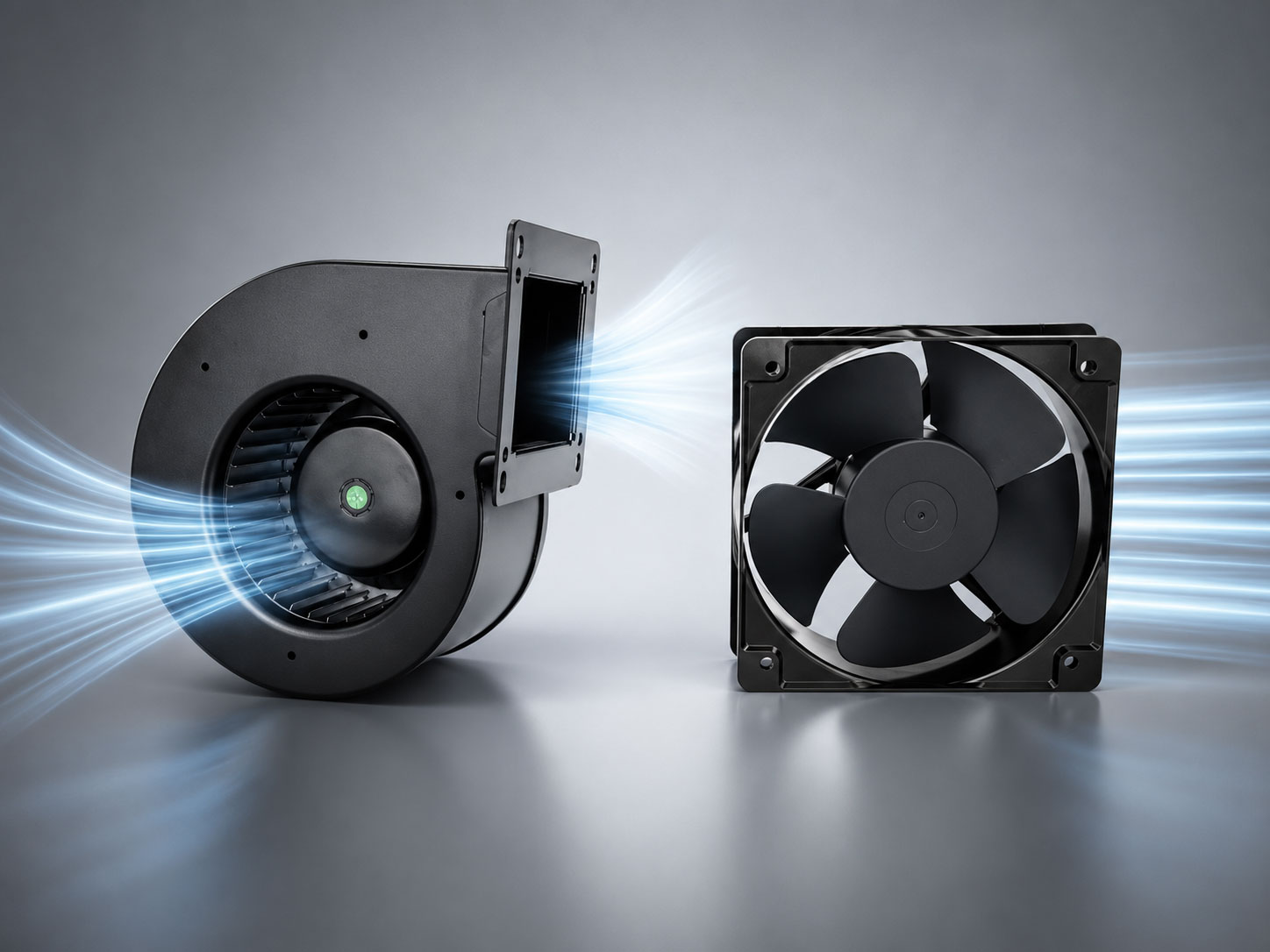
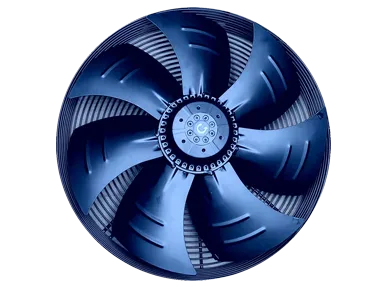
An axial fan is a fan that moves air in the same direction as the fan shaft, creating high airflow at relatively low static pressure. It is commonly used when a system needs large air volume with limited resistance.
Axial fans usually have propeller-style blades and are often installed in equipment panels, ventilation openings, condensers, heat exchangers and air circulation systems. They are suitable for applications where air can move directly through the fan path without long ductwork, dense filters or complex resistance.
In practical terms, axial fans are often selected for high-volume cooling and ventilation. SunxFan AC axial fans are designed for continuous airflow and can be used in harsh, dusty or humid industrial environments, with protection levels up to IP65 depending on the model.
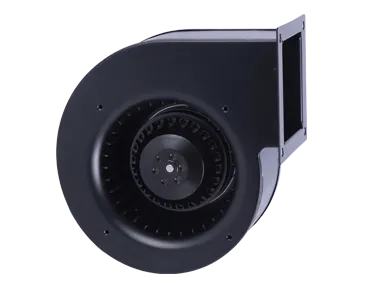
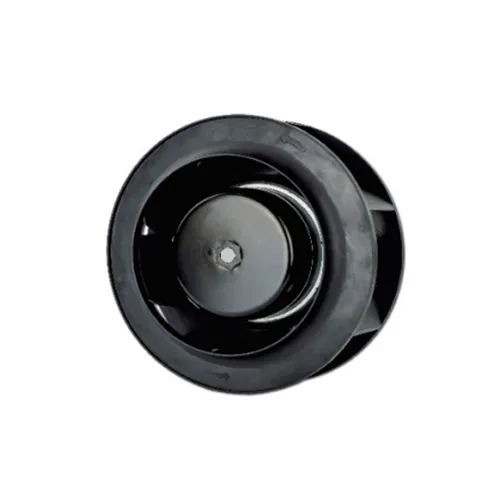
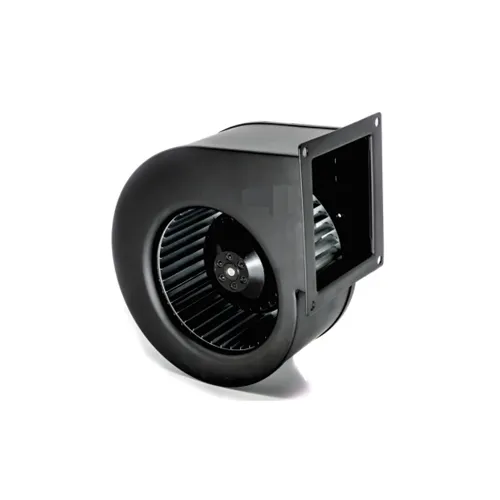
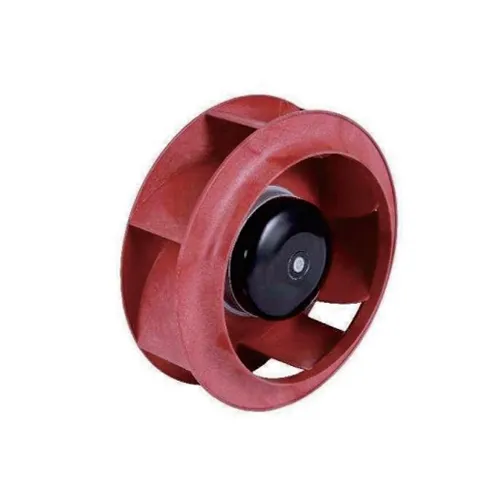
A centrifugal fan is a fan that draws air into the impeller and throws it outward by centrifugal force, producing stronger static pressure than many axial fan designs. It is commonly used when air must pass through ducts, filters, heat exchangers or compact equipment structures.
The Eurovent fan product definitions describe centrifugal fans as units where air enters the impeller mainly in an axial direction and leaves perpendicular to that axis. This explains why centrifugal fans are widely used in ducted HVAC systems, range hoods, air handling units, FFU systems, purifiers and refrigeration equipment.
SunxFan centrifugal fans include forward-curved and backward-curved options. Forward-curved centrifugal fans are often used where compact size, moderate pressure and steady airflow are required, while backward-curved fans are commonly preferred for higher efficiency and stronger pressure performance in many HVAC systems.
Axial and centrifugal fans use different aerodynamic principles to move air. An axial fan pulls air through the impeller and pushes it forward along the same axis as the rotating shaft. This straight-through airflow path makes axial fans particularly suitable for moving large volumes of air through relatively open systems. A centrifugal fan, by comparison, draws air into the center of the impeller and redirects it outward, usually at approximately 90 degrees to the inlet airflow. This change in airflow direction allows centrifugal fans to develop greater pressure and maintain airflow more effectively when the system contains significant resistance.
The following table summarizes the key differences.
| Comparison Item | Axial Fan | Centrifugal Fan |
|---|---|---|
| Airflow Direction | Parallel to the shaft | Air enters axially and exits radially or at 90° |
| Air Volume | Usually high airflow | Moderate to high airflow depending on design |
| Static Pressure | Lower pressure | Higher pressure capability |
| Best Use | Open ventilation, panel cooling, condenser cooling | Ducts, filters, air handling units, range hoods |
| Space Requirement | Thin and simple structure | More compact pressure-building structure |
| Resistance Handling | Better for low-resistance airflow paths | Better for ducts and high-resistance systems |
| Noise Behavior | Can be louder at high speed and open flow | Often easier to control in ducted systems |
| Typical SunxFan Product | AC/DC/EC axial fans | Forward-curved and backward-curved centrifugal fans |
For standardized fan performance, AMCA notes that Fan Energy Index can be calculated using laboratory test data from AMCA Standard 210 or ISO 5801, which are widely used for commercial and industrial fan testing. Buyers can refer to AMCA Fan Energy Index guidance when considering fan efficiency at real operating points.
Airflow direction is the most obvious difference between axial and centrifugal fans.
With an axial fan, air enters and leaves the fan in approximately the same direction, parallel to the shaft.
With a centrifugal fan, air normally enters near the center of the impeller and is redirected outward toward the discharge.
This difference affects not only fan construction but also how the fan can be integrated into an HVAC system or piece of equipment.
Axial fans are particularly effective when an application requires high-volume airflow through a relatively low-resistance path.
This is why axial designs are widely used for cooling condensers, electronic equipment and industrial machinery, where large amounts of air need to move directly across a heat source.
Centrifugal fans can also provide substantial airflow, but their major advantage becomes more apparent as system resistance increases.
Therefore, it is misleading to assume that axial fans are simply “high airflow” fans and centrifugal fans are “low airflow” fans. The correct comparison must consider both airflow and pressure at the required operating point.
Static pressure is often one of the most important factors when deciding between an axial and a centrifugal fan.
A simple open-air cooling application creates relatively little airflow resistance. In this situation, an axial fan may provide the required airflow efficiently.
However, resistance increases when the airflow path contains components such as:
Filters
Heat exchangers
Evaporator or condenser coils
Long ducts
Multiple duct bends
Dampers
Grilles
Dense equipment structures
As resistance increases, the fan must generate sufficient static pressure to maintain the required airflow.
For this reason, centrifugal fans are commonly selected for systems where higher static pressure is required.
Fan performance should always be considered as part of the complete airflow system.
In a simple system with a short, unrestricted airflow path, an axial fan may provide excellent performance. But once ducts, filters and heat exchangers are added, system resistance can increase significantly.
Centrifugal fans generally maintain useful airflow more effectively under these higher-resistance conditions.
A practical rule is:
Low system resistance + high airflow requirement → Consider an axial fan
Higher system resistance + pressure requirement → Consider a centrifugal fan
This is only a starting point. The final selection should always be checked against the actual fan performance curve.
Airflow and static pressure should be evaluated together rather than as separate specifications.
Every ventilation system produces resistance to airflow. As airflow increases, the pressure required to overcome this resistance also changes. At the same time, every fan has its own performance curve showing the relationship between airflow and pressure.
The actual operating point occurs where the fan performance curve and system resistance curve intersect.
This means selecting a fan only by its maximum airflow rating can lead to poor real-world performance.
For example, a fan may be rated for a high maximum airflow under low-resistance test conditions. Once installed behind a filter and heat exchanger, however, the actual airflow may be considerably lower.
When comparing axial vs centrifugal fans, engineers should therefore identify:
Required airflow, usually in CFM or m³/h
Required static pressure, usually in Pa or in. w.g.
Expected system resistance
Required operating point
Acceptable noise level
Motor and speed-control requirements
The best fan is not necessarily the one with the highest maximum airflow or largest motor. It is the fan that delivers the required airflow at the required pressure with suitable efficiency and noise performance.
There is no universal rule stating that one fan type is always more efficient than the other.
An axial fan operating close to its intended high-flow, low-pressure duty point can be highly efficient. A properly selected centrifugal fan may provide better system efficiency where greater pressure is required.
Motor technology also matters. EC motors with electronic speed control can help the fan adapt to changing system demand instead of operating continuously at full speed.
For OEM and HVAC applications, efficiency should therefore be evaluated at the actual operating point, not simply by comparing fan categories or maximum efficiency values.
It is also inaccurate to assume that all axial fans are noisier than centrifugal fans, or vice versa.
Fan noise is influenced by factors including:
Fan speed
Blade or impeller geometry
Diameter
Motor design
Operating point
Air turbulence
Inlet and outlet conditions
System resistance
Fan mounting
A poorly selected fan operating far from its optimum range can produce unnecessary turbulence and noise regardless of whether it is axial or centrifugal.
For noise-sensitive HVAC, residential, medical or electronic equipment, compare acoustic data at the required operating point rather than choosing only by fan type.
Axial fans have a straight-through airflow path and can often be integrated into systems where installation depth is limited.
Centrifugal fans redirect the airflow and therefore require a different installation layout. Depending on the design, sufficient space must be provided for the inlet, impeller and radial discharge.
This distinction can be important in compact equipment such as air purifiers, ventilation units, refrigeration systems and integrated HVAC products.
The available space should therefore be considered together with airflow and pressure requirements during the early design stage.
Different applications create different airflow resistance and installation requirements. The following table provides a practical starting point.
| Application | Typical Choice | Main Reason |
| Condenser Cooling | Axial Fan | High airflow through a relatively open path |
| Electrical Cabinet Cooling | Axial Fan | Direct airflow and compact installation |
| Server or Telecom Cooling | Axial Fan | High airflow for heat removal |
| General Ventilation | Axial Fan | Efficient movement of large air volumes |
| Air Handling Unit | Centrifugal Fan | Must overcome coils, filters and duct resistance |
| Air Purifier | Centrifugal Fan | Higher pressure required across filters |
| Heat Recovery Unit | Centrifugal Fan | Must overcome heat exchanger resistance |
| Range Hood | Centrifugal Fan | Suitable for filtration and exhaust duct resistance |
| Long Duct System | Centrifugal Fan | Better capability under higher static pressure |
| Dehumidification Equipment | Centrifugal Fan | Suitable for restrictive internal airflow paths |
Choosing between axial and centrifugal fans means matching fan performance to airflow demand, static pressure, installation space, duty cycle, temperature, noise limit and environmental conditions. A fan should be selected based on the system curve and operating point rather than only diameter or rated airflow.
Choose an axial fan when the system needs large air volume with low resistance, such as cabinet cooling, condenser ventilation, machinery cooling, air circulation or direct exhaust. Choose a centrifugal fan when the airflow must overcome duct resistance, filters, heat exchangers, bends, silencers or compact enclosure pressure loss.
The AMCA fan terminology handbook is useful for understanding fan categories, airflow terms and standard definitions. For test methods, ISO 5801 specifies procedures for determining fan performance using standardized airways, helping buyers compare products based on consistent performance data.
For OEM buyers, SunxFan can help evaluate fan type, motor type, airflow, pressure, size, voltage, protection level and control method. EC fan options are especially useful when projects require variable speed control, lower energy consumption and intelligent system integration.
The main difference between axial fan and centrifugal fan is airflow direction and pressure capability. Axial fans move air straight through the fan and are best for high airflow and low resistance. Centrifugal fans redirect air through the impeller and are better for higher static pressure, ducted systems and equipment with airflow resistance.
For buyers, the best fan is not simply axial or centrifugal; it is the fan that matches the required operating point. SunxFan provides axial fans, centrifugal fans, EC fan solutions and customized ventilation support for HVAC equipment, refrigeration, air handling, range hoods, electronics cooling and industrial airflow systems.
An axial fan moves air parallel to the shaft, while a centrifugal fan draws air into the impeller and discharges it outward, usually at about 90 degrees.
Centrifugal fans usually provide higher static pressure, making them better for ducts, filters, heat exchangers and systems with airflow resistance.
Axial fans often provide high airflow in low-resistance applications, such as direct ventilation, condenser cooling and panel cooling.
A centrifugal fan is often better for ducted HVAC systems, air handling units, range hoods and air purification equipment because it can overcome system resistance more effectively.
Axial fans can be efficient in low-pressure, high-volume applications, but efficiency depends on the operating point, motor type, blade design and system resistance.
SunxFan provides EC, DC and AC axial and centrifugal fan solutions for HVAC, industrial ventilation, refrigeration, air handling and equipment cooling, with support for customized airflow and pressure requirements.
Quick Links
 中文
中文  English
 한국어
한국어 français
 Deutsch
 Español
 italiano
 русский
 português
 العربية
 Türkçe
 Polska